
What a "twitter ban service" actually is — and what it can't be
Type "twitter ban service" into a search bar and the results split into two very different things. One cluster is sellers who promise to get any account you name suspended, usually through mass-reporting or bots. The other is people quietly trying to stop an account that is impersonating them, leaking their address, or running a harassment campaign. Redactly is a personal-data removal service, and we only do the second kind. Knowing which one you actually need saves you money and, sometimes, your own account.
Here is the mechanic almost nobody selling the first version will tell you. X does not suspend accounts because they were reported a lot. Enforcement is not a vote, and it is not for sale. A reviewer — human or automated — checks a reported account against a specific rule, and only a genuine violation gets actioned. Paying a service to flood the report queue does not change that outcome. It just moves your money.
So a legitimate "twitter ban service," in the only sense that works, is really a reporting-and-removal service: document the violation, file it under the correct policy through X's official channels, then clean up whatever the account already exposed before it was taken down. That last step is the part most guides skip, and it is where the lasting damage usually lives. It is also the part the team that handles these cases spends most of its time on.
Is an "x ban service" any different?
No. An "x ban service" is the same search with the newer brand name. Since the platform rebranded from Twitter to X, both phrases point at one enforcement system, one set of report forms, and one Trust and Safety team. People searching either one are describing the same problem: an account is hurting them and they want it gone. The process below is identical whether you still call it Twitter or X.
When X will actually ban or remove an account
X restricts an account when it breaks a written rule, not when someone dislikes it. For the situations Redactly handles, four grounds do most of the work. Impersonation: an account pretending to be you or your business to deceive, covered by X's authenticity and impersonation policy. Targeted harassment: repeated abuse, threats, or a coordinated pile-on aimed at one person. Doxxing: posting your private information, such as a home address or phone number, which X treats as a serious violation with faster review. Ban evasion: someone already suspended spinning up a fresh handle to keep going.
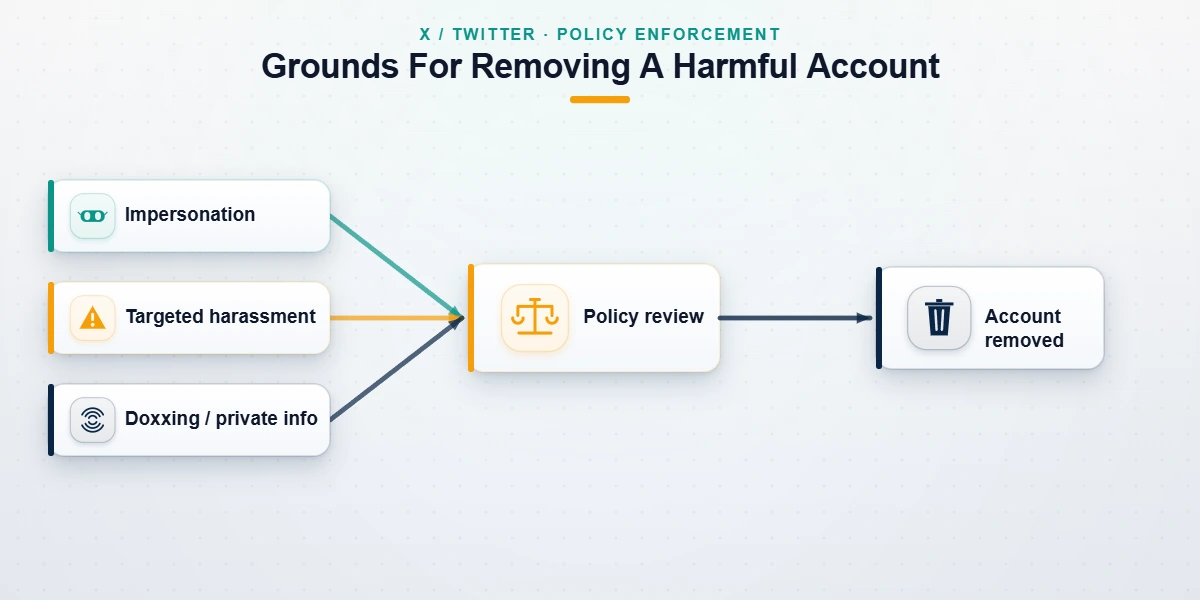
Two details change what is realistic. First, X quietly retired its standalone "misinformation" report option back in September 2023 and pushed that to Community Notes, so "this is false" is no longer a reporting route on its own; the claim has to map to harassment, impersonation, or another live rule. Second, since the April 2025 update to its parody and fan-account rules, accounts that clearly label themselves as parody are much harder to remove on impersonation grounds. Picking the door your case actually fits before you file is half the battle. Filing under the wrong one is the single most common reason a report comes back with no action.
How to report an impersonation, harassment, or doxxing account on X
Reporting well comes down to evidence and picking the right category. Here is the sequence we walk clients through.
- Capture everything first. Before you report or block, screenshot the profile, the offending posts, the handle, and the URL, with visible timestamps. Accounts get deleted mid-review, and once a post is gone your screenshot may be the only proof it existed.
- Report from the post, not just the profile. On the specific post, open the menu, choose "Report post," then follow the abuse or impersonation path that matches your case. Post-level reports hand X the exact content to review.
- File the dedicated impersonation form. For a fake account using your name or photos, X's impersonation report form carries more weight than an in-app tap and lets you attach a government ID.
- If you are being doxxed, flag the private information explicitly. Choose the private-information reason. These reports are reviewed faster because they involve real-world safety.
- Keep the reference numbers. Every report generates a case reference. Save them so you can escalate or appeal.
A practitioner note from our desk: when we file impersonation reports with a clean evidence pack and the right form, X usually gives a first response within a few days, and cases with attached ID move faster than in-app taps that reviewers see thousands of. It is unglamorous work. The documentation is what gets the result.
Not sure which policy your case fits, or staring at an account that already leaked your address? Start with a free exposure scan and we will map what X can action and what needs removing elsewhere, before you pay anything.
How long does removing an X account take?
There is no fixed clock, but patterns hold. Straightforward impersonation reports with a complete evidence pack, and ID where relevant, tend to get a first response within a few days; we have seen clean cases move in under 48 hours and messier ones sit for a week. Doxxing reports flagged as private-information exposure are generally reviewed faster than ordinary abuse reports, because they carry real-world weight. Harassment cases built on a pattern take longest, since a reviewer has to see the whole campaign, not one rude reply.
Two things reliably slow a case down: filing under the wrong policy, which drops it into the wrong queue, and thin evidence that forces a reviewer to guess. Two things speed it up: post-level reports that hand X the exact content, and, for impersonation, the dedicated form with ID attached. If an account is suspended and then returns under a new handle, the ban-evasion report tends to move quicker than the first one, because X can link the new account to an already-actioned violation. Removing the content the account posted runs on its own, slower timeline, which the next sections cover.
What reporting can't do — and how to spot a fake "ban service"
Now the honest part, because this is where the scam version of a "twitter ban service" preys on people. Reporting is not a guaranteed ban. X does not action every report, it rarely explains its reasoning, and truthful-but-unflattering posts, criticism, and public-record information usually stay up because they break no rule. Anyone promising a certain suspension of a named account is either lying or planning to break X's own manipulation rules on your behalf, which can drag your own account into the enforcement.
A few red flags separate a real service from a con:
- Guaranteed bans. No one controls X's decision. We can't either, and we say so in our service disclaimer.
- Password requests. No legitimate service needs your X password. If someone asks, walk away.
- Upfront crypto-only demands. Real firms invoice. They do not insist on irreversible payment before lifting a finger.
- Forged legal notices. Filing a fake DMCA or court notice is a crime, not a service.
If a seller has already taken your money on one of these promises, report it to the FTC at reportfraud.ftc.gov. Redactly opens every engagement with a free exposure scan precisely so you can see what is realistically removable before any money changes hands.
Cleaning up what the account already exposed
Suspending an account does not un-ring the bell. By the time you report a doxxing or impersonation account, the information it posted has often been screenshotted, reposted, or scraped onto people-search and data-broker sites, and those do not care that the original X account is gone. This is the cleanup that "ban service" pitches never mention, and it is the core of what Redactly actually does.
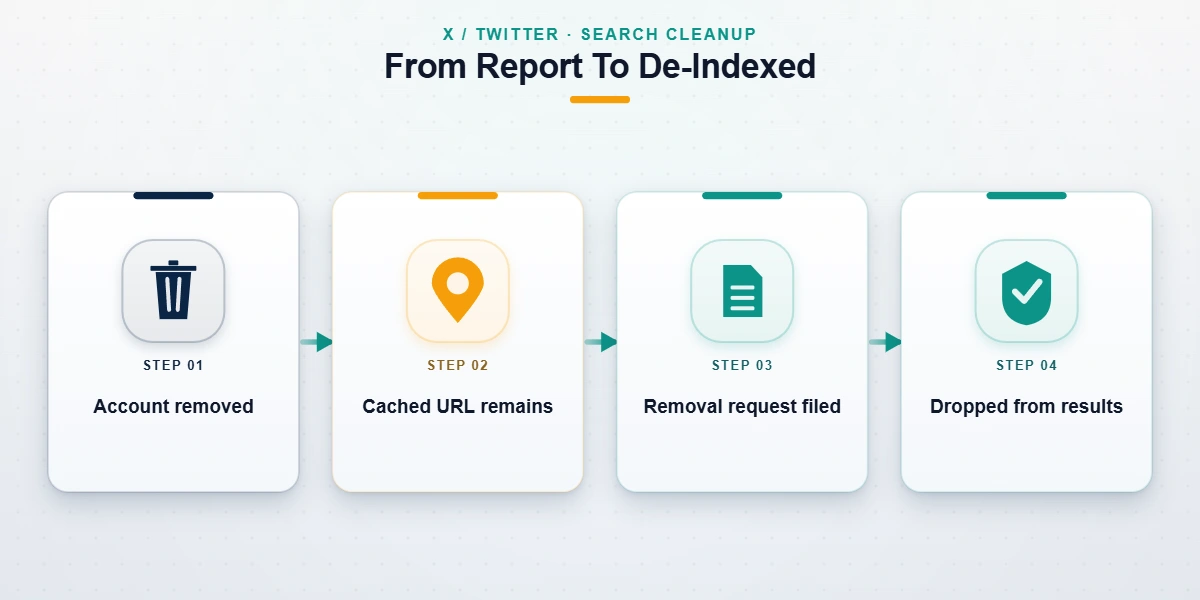
The work runs on two tracks. First, search de-indexing: if the harmful content still shows in Google under your name, you can request removal of pages exposing personal contact details through Google's "Results about you" tool, and we prepare those requests so they meet Google's criteria on the first pass. Second, source removal: we trace where the leaked address or phone number re-surfaced, often a data broker such as Spokeo, Whitepages, or BeenVerified re-listing it from a public feed, and file opt-outs through the channel each broker actually honours. As of July 2026, our internal records show impersonation-linked doxxing cases touch a median of nine broker or people-search listings, so a single X suspension is rarely the end of the job. It is the first step, not the last.
How we handle the evidence you share
Because this topic involves screenshots of abuse and sometimes your ID, how a service treats that material matters as much as what it removes. Redactly collects the minimum needed to file: the URLs, the evidence pack, and the identifiers X requires, and nothing extra. We never ask for your X password, and we do not need account access to file a report for you. Evidence is stored only while the case and any appeal window are open, then purged. If you are covered by the GDPR or a US state law like the CCPA, the same erasure rights you are exercising against the harmful account apply to us too; our privacy practices spell out what we keep and for how long. For anyone in an active safety situation, a stalker or an abusive ex, say so at intake so we route the case to a specialist rather than the standard queue.
When to bring in help — and what it costs
You do not need a service to file one impersonation report. The steps above are free, and you can do them yourself in about twenty minutes. Bring in help when the problem is bigger than a single form: an account that keeps returning under new handles, the same private data re-listed across a dozen sites, or a harassment situation where you should not have to stare at the abuse to document it. If the same person is coming at you on Instagram too, the playbook carries over — our Instagram ban service guide walks through the equivalent steps for a harmful Instagram account. Redactly's role is to run the reporting, the evidence, and the downstream de-indexing as one case instead of a scramble.
Every engagement opens with a free exposure scan. No charge, no card, no password, showing what X can action and what needs removing elsewhere. From there, scope and pricing are laid out in plain terms before you commit, and the engagement terms cover exactly what a case includes. If your situation is urgent, tell our team what is happening and we will triage it quickly. The goal is not to sell you a ban that no one can promise. It is to get the harmful account actioned through the real channels, and to remove what it left behind.