What an "Instagram ban service" actually is
An Instagram ban service is a paid offering that promises to get a specific Instagram account suspended or disabled for money. You will find it advertised on grey-market forums, invite-only chat servers, and throwaway websites, and it gets sold under a rotating set of names. The same product shows up as instagram ban services, an instagram banning service, ban as a service instagram, instagram ban as a service, or simply ban service instagram, and the pitch barely changes: name a target, pay a fee, and the account supposedly disappears. Much of the trade happens out of sight. A search like instagram ban service discord leads to disposable servers and Telegram channels rather than to a company with a name, an address, and something to lose.
Strip away the branding and every instagram account ban service is selling one of two things. The first is coordinated reporting: a batch of accounts, real or fake, all filing the same complaint against a target at once. The second, and the one that actually moves the needle, is fraud, where the seller builds a lookalike profile and reports your genuine account as the impostor. Neither is something Redactly offers, and neither is something we will set up for you. If you want to know who is telling you this, the team behind Redactly's privacy work has spent years mapping how these campaigns get built. What follows is an honest look at how they operate, whether they deliver, and what to do when you are the one on the receiving end.
How do Instagram ban services claim to work?
People searching "how do instagram ban for service work" usually want the mechanics without the sales gloss, so here they are. There are two engines, and they are not equally effective. Seeing the difference clearly is what legitimate account protection looks like in reverse.
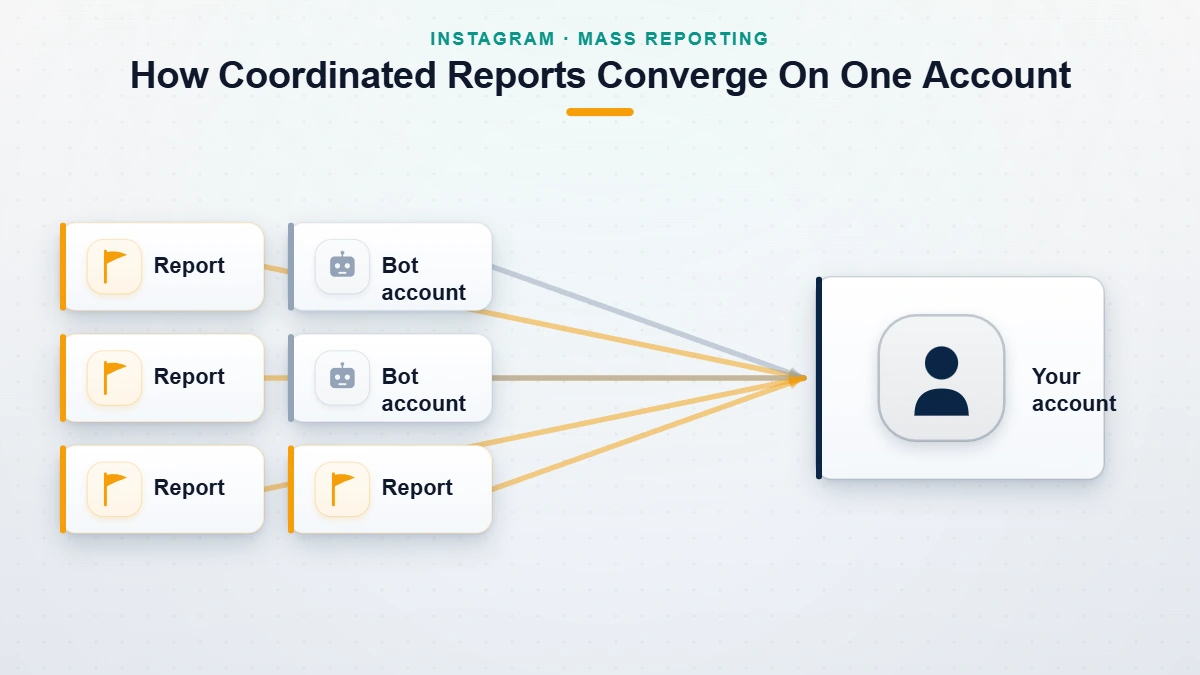
The crude engine is volume. A seller controls a pool of accounts, some purchased and some bot-run, and points them all at one profile, filing the same complaint category inside a short window. The theory is that a spike of reports reads as a signal Instagram has to act on. It mostly does not, which is why the volume-only sellers are the ones most likely to take the money and go quiet.
The engine that actually gets accounts pulled is uglier. The operator clones the target down to the profile photo, the bio, a near-identical handle, and sometimes a faked verification badge, then reports your real account for impersonating the clone. Instagram's impersonation process exists to protect real people from fakes, and when a review is rushed, the honest account is the one that can lose. A second common move is filing false self-harm or credible-threat reports, because those categories get fast-tracked to human reviewers. Both methods abuse a safety system built to help people, which is precisely why the platform has spent recent years hardening against them.
Do Instagram ban services actually work, or is it a scam economy?
Mostly a scam economy. The reference point almost everyone cites is Vice Motherboard's 2021 investigation, which found sellers charging roughly $60 to attempt a ban and $3,500 to $4,000 to "restore" an account afterward (Vice Motherboard, 2021). Sit with that pricing for a second. The same underground market both takes accounts down and sells the cure, and the restore fee runs about fifty times the ban fee. Kaspersky and Avast documented the identical playbook that year (Kaspersky, 2021).
The economics give the game away. When one party profits from both the disease and the medicine, "does it work" is the wrong question, because the business model is the con. Plenty of buyers pay the $60, watch nothing happen, and have zero recourse, since they just paid a stranger in a chat room to commit a policy violation on request. Others do see a target flicker offline for a few days, then reappear on appeal, at which point a "restoration" upsell mysteriously lands in that target's inbox. As of mid-2026 the honest summary holds steady: coordinated reporting is far less reliable than the ads imply, Instagram removes accounts for confirmed policy violations rather than raw report counts, and the money mostly flows to whoever is best at sounding convincing. Refusing this kind of work is one of the lines we will not cross, and it is worth understanding why the category tends to collapse under its own claims.
What really happens when a report is filed
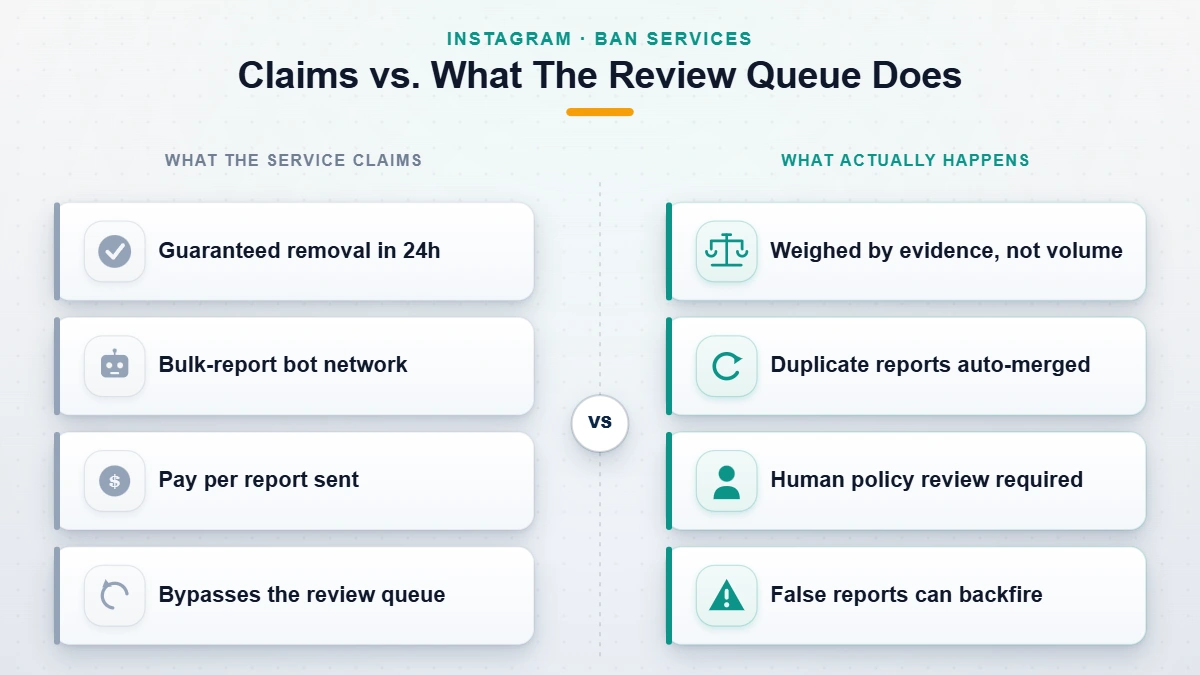
Here is the gap between the pitch and the process. An instagram banning service sells certainty: pay, and it is done. Instagram's real enforcement is a review pipeline, and it does not count votes.
When any account is reported, the complaint enters a queue where automated classifiers, and for serious categories human reviewers, check the content against the Community Guidelines. Removal follows a confirmed violation, not a tally of complaints. That is the single most important fact for anyone worried about a pile-on: one hundred coordinated reports against a clean account are one hundred reports that fail review. It is also why the impersonation trick is the dangerous one, since it manufactures an apparent violation instead of just shouting louder. Meta publishes what it actions in its Transparency Center, and the through-line is that automated detection of fake and coordinated accounts, not user report volume, drives the bulk of enforcement (Meta Transparency Center, 2025). A service betting on volume is betting against the way the system is built. The same holds true off Instagram. When the target is an X account instead, the Twitter ban service pitch and how to remove a targeted X account run on the same broken logic.
Is it legal to pay for an Instagram account ban service?
The short version: paying to take down someone's account is a bad idea legally as well as ethically, and the risk cuts both ways.
Every method a ban instagram service relies on breaks Instagram's Terms of Use. False reporting, impersonation, and running fake accounts are all prohibited, and Meta can disable accounts tied to the scheme, the buyer's included. Past the platform's own rules, deliberately filing false reports to remove someone can shade into harassment or cyberstalking under many jurisdictions' laws, and the impersonation-and-fraud method can pull in identity-misuse statutes. If money changed hands and nothing was delivered, which is the usual outcome, you have also just been defrauded by someone you cannot report to the police without explaining what you were trying to buy. Whether it is dressed up as a ban instagram account service with a dashboard or sold as three lines in a forum post, none of that changes.
There is a cleaner mirror image worth naming. If your account was wrongly disabled because someone weaponized reports against you, that is not a crime you committed, it is one committed against you, and the answer is an appeal plus documentation rather than a counter-strike. If a "restoration" service scammed you, the U.S. Federal Trade Commission takes those reports at reportfraud.ftc.gov. Legitimate removal work is boring by comparison: a named company, plain service terms, and a free scan before any charge.
Think a campaign is pointed at you right now? Redactly's analysts can run a free exposure scan to find the personal data an attacker would use to clone or dox you, then start removing it. Talk to a removal advisor. No passwords, no crypto, and we never get anyone else banned.
Signs you are the target of a coordinated ban attack
Most people do not go shopping for a ban service. They land on a page like this because they suspect one is aimed at them. A handful of patterns show up again and again in the cases we map.
A sudden wave of notifications tells you your posts or account were reported, often clustered within minutes. A near-copy of your profile appears, sometimes wearing a fake verified badge, and your followers start asking which account is the real one. You pick up a warning or a temporary restriction for a violation you know you did not commit. Or you are abruptly locked out and the recovery email never arrives. Any single one of these can be ordinary noise. Several of them inside a short window read like coordination.
Now the practitioner note. When we map exposure for someone caught in one of these pile-ons, the attacker almost never guessed anything, because they pulled the target's face, bio, employer, and sometimes home city straight off a people-search listing to assemble a convincing clone (our exposure scans, as of July 2026). The reporting is the visible half. The data that made the impersonation possible is the half you can actually take back, and it is the focus of our privacy and takedown guides. That is the difference between waiting out a ban and removing the raw material an instagram ban account service needs to run the same play again next month.
How to protect your account and cut off the data attackers exploit
Defense splits into two jobs: hardening the account and shrinking the exposure that makes you worth targeting. Whether the threat is dressed up as a ban instagram account service or a slick "takedown" dashboard, the countermeasures are the same.
On the account: switch on two-factor authentication with an authenticator app or a hardware key instead of SMS, set a recovery email you have never published, and confirm your login details are current. If a clone shows up, report it through Instagram's impersonation form quickly, since that form works even when you are logged out and removing the fake collapses the whole impersonation method. If your real account was wrongly disabled, use Instagram's official appeal route at help.instagram.com rather than a third party promising a paid "restore." Meta does not charge to review an appeal, and no legitimate service can skip that queue for you.
On exposure: the reason an instagram account banning service can clone you convincingly is that your photo, bio details, workplace, relatives, and address are already sitting on data-broker and people-search sites, ready to copy. Removing them is ongoing work, because brokers re-list from public feeds, so it is maintenance rather than a one-time delete. It is also the half of the problem you can genuinely control. This is the core of what Redactly does, and how we handle the data you share while we do it. We open every engagement with a free exposure scan, we never ask for your password, and we will not, under any circumstances, run a ban campaign against another person. If you want that scan, start here.